

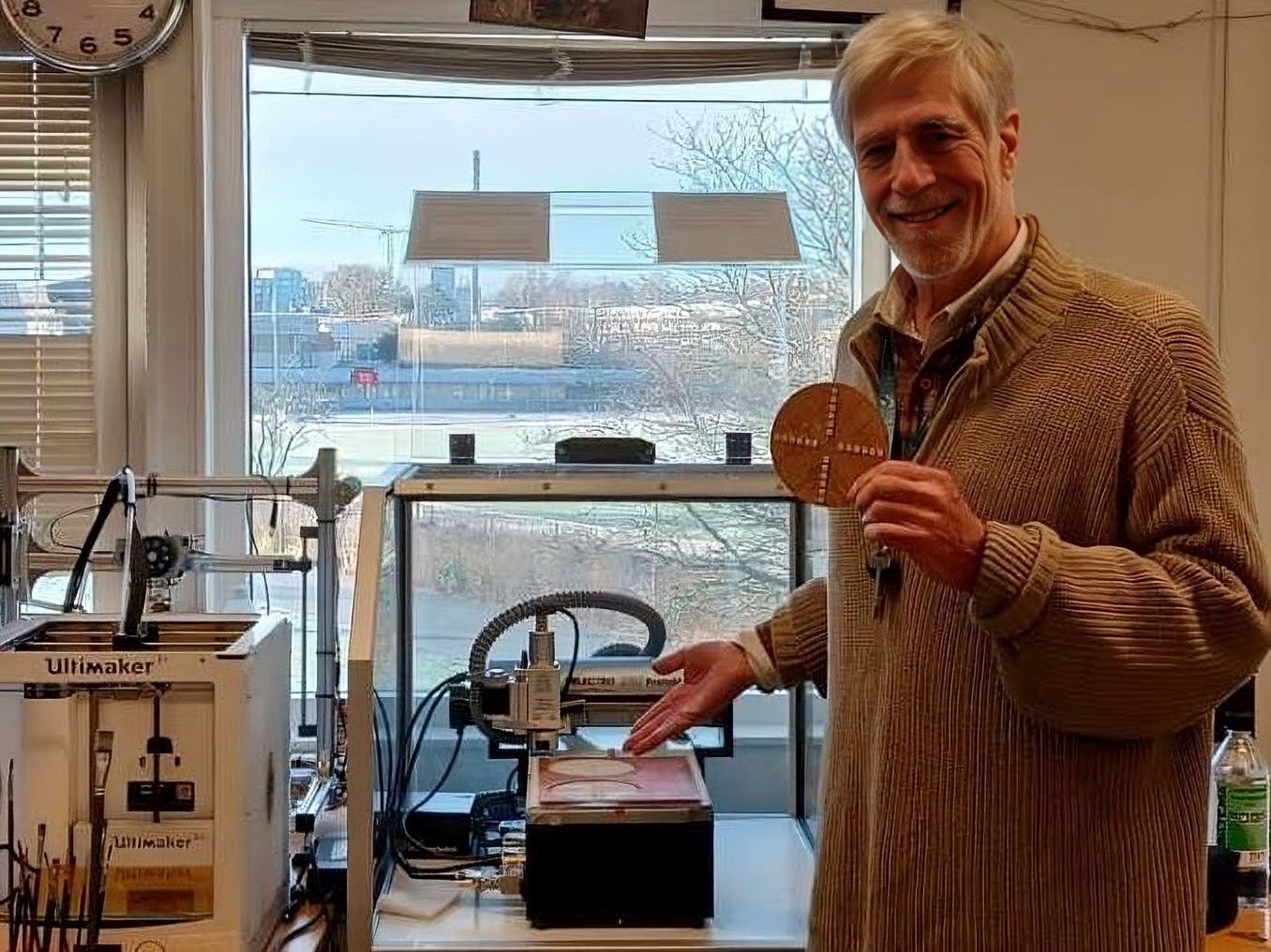
In an educational landscape often defined by strict tests and structured pathways, it is a rare and powerful thing to encounter a story that challenges the very definition of success. I found this type of story during a recent afternoon spent with Professor Emeritus Mark Smith in the vibrant, eclectic heart of the Mentorspace. Surrounded by the creative energy of the Mentorspace, Mark told his story. It wasn’t a simple climb to the top, but a winding path shaped by his endless curiosity, the mentors who guided him, and his deep faith in students. Mentorspace gives access to modern equipment and useful tools that give students the opportunity to discover and give vent to their passion through practical work. It serves as a powerful testament to the idea that our greatest achievements often spring not from knowing the right answers, but from having the courage to ask messy, difficult, and unusual questions.
Mark’s own journey into the world of science and technology began not in a classroom, but in the everyday wonders of his childhood home in Northern California. He described himself as a child captivated by the hidden mechanics of the world, from the complex workings of a washing machine to the simple, seemingly magical glow of a light bulb. ”I was absolutely fascinated by things that plugged into the wall,” he recalled with a smile, even confessing to the classic, if ill-advised, experiment of plugging his fingers into the wall. This was not mere misbehaviour, but the first step of a lifelong quest to understand the invisible forces that power our lives. His fascination soon grew to uncover the mystery of radio, a device most saw as magic, but which he saw as a puzzle begging to be solved. ”What makes a radio go?” he wondered, a question that would ultimately lead him down a path of electric circuits and a lifelong love of building and creating with his own hands.
What is most striking about Mark’s path is that the very mind hungry for knowledge never believed it was destined for higher education. ”I actually didn’t think I was going to go to university,” he stated with striking honesty, financial pressures and his self-professed status as a student who ”wasn’t the greatest in the world.” He was surrounded by a narrative that said without top grades, college was an impossible dream, a closed door. A dedicated high school physiology teacher however convinced him to apply to college. Then, while working a university lab job, an employer noticed his inner talent for designing electronics and asked a life-changing question: ”Have you thought about going to graduate school, getting a masters or more?” Mark laughed at the suggestion, but his mentor would not be deterred, instead he told him to research a field called ”biomedical engineering.” That single piece of advice, followed by a trip to the library in the pre-internet era, set him on a path that would lead to a master’s degree and a transformative 21-year career at Hewlett-Packard in Silicon Valley.
It was this experience in the collaborative, high-diversity environment of Silicon Valley that directly inspired the creation of the Mentorspace. Mark realized that true, world-changing innovation can not happen in isolated academic environments. ”KTH is a technical university,” he explained, ”But I need everything.. because everything has technology in it. I had to have art, I had to have music. I needed to have film production. I needed to have healthcare. I needed to have medicine. I needed to have civic planning and community and politics. I needed all of it and no university can do it all” The Mentorspace was born from this need for radical collaboration. Mark is very passionate about pointing out that it is not a makerspace. It is not about access to tools, but about access to each other. It is a ”knowledge exchange,” a living network where students from different schools and backgrounds can collide, their diverse perspectives connecting dots that would otherwise remain separate. He speaks of the space with devotion, explaining that its value grows with every new person who joins. It is a safe place where failure is not just tolerated but celebrated as an essential part of learning, a philosophy represented by the annual celebration of the “Great Mentorspace Fire,” an incident where a student’s project set off every fire alarm in a building in Kista.
When our conversation turned to programming, Mark offered a refreshing perspective. He taught himself to program not for a grade, but to solve a real problem – analyzing rat behavior for his master’s research. ”I had never written a line of program in my life,” he said, emphasizing that programming, like any tool, is most powerful when driven by a specific purpose, a ”programming for what?” This philosophy extends to the Mentorspace’s approach to all technology, including AI, which he views not as a threat, but as another tool for creative people to manage. It is this mindset that makes the Mentorspace such an important resource. It is a place to discover your ”for what?” – to find the project, the idea, the collaboration that gives your skills meaning and direction.
Beyond the professor and innovator is a man of deep and varied passions that fuel his creative spirit. He is a dedicated cyclist, commuting 30 kilometers daily on a non-electric bicycle, finding clarity and peace on his rides. He is an enthusiastic outdoorsman who finds comfort in the heavy silence of the desert, a landscape he holds dear. ”The night sky just takes your breath away. The stars are my friends,” he shared, revealing a personal connection to the natural world that grounds his technological pursuits. Mark is also a lifelong music lover, a passion born from his days as a university radio DJ. ”When I go home, music is always playing. It’s never silent,” he told me, his face lighting up as he recommended the experimental jazz group Oregon and the brilliant pianist Keith Jarrett, revealing a personal server in the Mentorspace.
As our conversation drew to an end, Mark shared a guiding principle from author Peter Drucker that has shaped his later years: ”After you have had success, now go and have significance.” It took him a long time to understand this difference. Success for most people means achieving social recognition – the good grades, the impressive job titles, the social approval we are taught to chase. But significance is something deeper and more lasting. It is about making a visible, positive impact on the world around you, about leaving things better than you found them.
This is the ultimate promise and purpose of the Mentorspace. It is more than just a room with equipment; it is an open door to a different way of thinking about your education and your future. It is an invitation to start building a life of significance right now, not someday in the distant future. Here, your ideas are protected, your intellectual property remains yours, and your failures are seen as essential steps toward understanding. In a world that often tells students to wait their turn, the Mentorspace says your time is now. It is a living answer to that pressing question of why we can not pursue what truly matters from day one. For any student wondering what lies beyond the next exam, the door is open, and the journey toward real significance begins the moment you choose to walk through it.